




Global demand for high-quality, affordable therapeutics has positioned the Indian pharmaceutical sector as an indispensable engine of international healthcare delivery. Beyond traditional Western and Latin American destinations, the trade corridor connecting Indian drug suppliers with Commonwealth of Independent States (CIS) nations and Central Asian republics has grown substantially. Businesses, healthcare procurement entities, and distributors actively evaluate options for pharma export to CIS and Central Asia to satisfy domestic healthcare requirements, expand therapeutic access, and secure reliable supply chains.
The nations comprising the CIS and Central Asian subregions rely heavily on imported pharmaceutical finished formulations, active ingredients, and specialized healthcare solutions. India’s robust manufacturing architecture, combined with strict compliance standards, creates an ideal synergy for trade across these territories. Companies like Cureton Biotech participate in this global market framework, supporting the movement of pharmaceutical goods across international borders through structured quality and export channels.
In this comprehensive guide, we explore the structural mechanisms of pharma export to CIS and Central Asia, detailing market dynamics, regulatory documentation, country-specific considerations, export processes, and key requirements for choosing an international pharmaceutical trade partner.
Navigating international pharmaceutical supply chains requires distinguishing between geopolitical groupings and geographical entities. While often discussed together, CIS markets and Central Asian countries represent distinct regulatory environments, economic conditions, and healthcare priorities when planning pharma export to CIS and Central Asia.
The Commonwealth of Independent States (CIS) represents a regional alliance formed by former Soviet republics. The pharmaceutical ecosystem within CIS member states is characterized by evolving regulatory frameworks, centralized healthcare procurement, growing private pharmacy retail, and an increasing emphasis on mandatory local product registration. Key countries in this sphere look to established international manufacturing centers to fulfill chronic and acute care demands.
Central Asia specifically refers to five sovereign nations:
While several Central Asian nations are also members or associate partners of the CIS, treating them as a uniform bloc can lead to supply chain inefficiencies. Each nation maintains its own ministry of health, distinct drug registration timelines, language requirements for product packaging, and import tariff schedules. Executing a successful pharma export to CIS and Central Asia strategy requires tailoring product portfolios to match the specific regulatory landscape of each target nation.
The strong commercial relationship supporting pharma export to CIS and Central Asia from Indian pharmaceutical suppliers is driven by several systemic factors that benefit both healthcare providers and patient populations.
India hosts one of the world’s largest concentrations of modern pharmaceutical production facilities. Indian pharmaceutical companies in India operate advanced infrastructure capable of producing high-volume solid, liquid, sterile, and topical formulations that comply with international quality protocols.
The breadth of product portfolios available from medicine exporters in India allows overseas buyers to consolidate procurement. From essential broad-spectrum anti-infectives to complex chronic therapies for cardiovascular, metabolic, and neurological disorders, Indian suppliers cover almost every major therapeutic category.
Generic medicines from India offer substantial cost advantages without compromising bioequivalence or safety profiles. This affordability allows public health ministries and private buyers exploring pharma export to CIS and Central Asia to stretch healthcare budgets and provide affordable access to vital drugs.
Decades of active trade have created mature shipping lines, freight pathways, and customs clearing protocols tailored specifically for pharma products export into Eurasia. Companies like Cureton Biotech leverage these established networks to support structured, compliant international transactions.
A successful campaign for pharma export to CIS and Central Asia relies on matching local epidemiological demands with appropriate dosage forms. Importers in these regions source a wide spectrum of generic and specialty formulations.
Regulatory compliance is the cornerstone of international drug distribution. Unregulated or non-compliant trade exposes businesses to severe legal penalties, product seizures, and supply disruption. Managing pharma export to CIS and Central Asia orders requires meeting multi-layered regulatory demands.
Before any pharmaceutical product can be commercialized in countries like Kazakhstan or Uzbekistan, it must be officially registered with the national Ministry of Health or equivalent regulatory agency. The registration process evaluates the drug’s safety, therapeutic efficacy, chemical stability, and manufacturing standards.
Exporters involved in pharma export to CIS and Central Asia must provide validated documentation proving that manufacturing facilities follow current Good Manufacturing Practices (cGMP). Common regulatory requirements include:
Language compliance is critical across Eurasian trade corridors. Packaging materials, blister backings, outer cartons, and Patient Information Leaflets (PIL) must typically feature bi-lingual or multi-lingual text—commonly Russian along with the national language (e.g., Kazakh, Uzbek, or Kyrgyz) of the destination market.
Precision in documentation prevents customs delays and ensures smooth commercial clearance at international borders. Importers and Indian pharma exporters coordinating pharma export to CIS and Central Asia must prepare a comprehensive documentation dossier for every shipment.
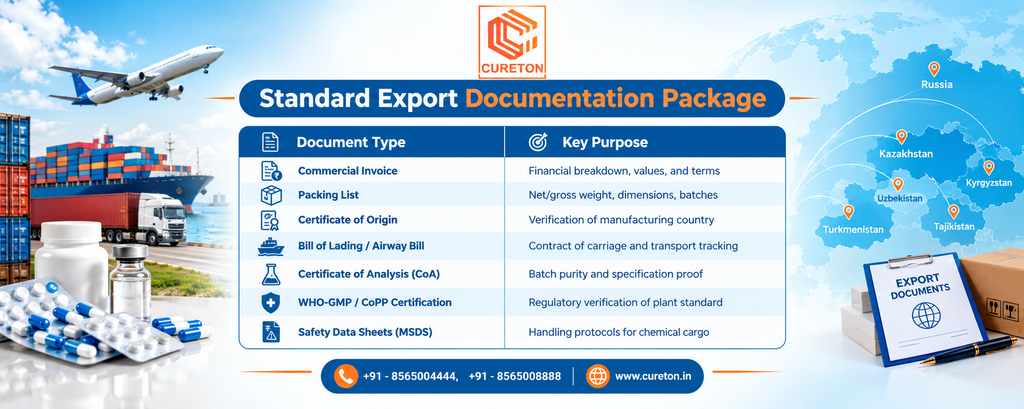
Exact documentation profiles vary based on the destination nation’s border regulations, the product’s therapeutic class, and specific contractual terms agreed upon by the importer and vendor.
Exporting medicines across international territories follows a structured, step-by-step operational workflow. Adhering to this lifecycle ensures quality retention from the factory floor to the final destination pharmacy during pharma export to CIS and Central Asia.
The buyer and exporter identify specific pharmaceutical formulations required for the target market, taking into account local disease prevalence and market competition.
The exporter prepares technical documentation—such as Common Technical Documents (CTD) or eCTD dossiers—to support marketing authorization filings in the destination country.
Formal agreements are established between the exporter and licensed regional distributors, outlining territorial rights, regulatory duties, and commercial terms.
Upon securing necessary import permissions, purchase orders are issued, and commercial contracts are finalized for pharma export to CIS and Central Asia.
Formulation lines produce the designated batch under validated GMP conditions. In-process analytical controls monitor tablet hardness, dissolution, packaging seal integrity, and fill volumes.
Products are packaged in localized foils, cartons, and boxes featuring approved regional scripts, regulatory registration numbers, batch numbers, manufacture dates, and expiration markers.
Qualified Person (QP) or QA teams review the batch manufacturing records (BMR) and issue a Certificate of Analysis (CoA) prior to clearing cargo for dispatch.
Cargo is loaded into controlled transit containers—utilizing temperature monitoring for cold-chain lines where necessary—and transported via air or multimodal sea-land routes.
Destination customs authorities verify shipping manifests, registration certificates, import permits, and CoA documents before releasing the cargo.
The licensed local distributor receives the shipment, conducts incoming inspection, and transfers goods into national distribution channels.
Each nation within the Central Asian pharmaceutical market and broader CIS zone offers distinct commercial environments for pharma export to CIS and Central Asia. Below is an analytical breakdown of five primary Central Asian nations.
As one of the largest economies in Central Asia, Kazakhstan maintains a well-regulated healthcare infrastructure.
Uzbekistan represents one of the fastest-growing pharmaceutical consumer markets in Central Asia due to its substantial population size and ongoing healthcare reforms.
Kyrgyzstan operates an open, trade-friendly market environment, though it requires careful regulatory planning.
Tajikistan’s pharmaceutical market relies heavily on international imports to satisfy domestic healthcare needs.
Turkmenistan presents a unique, state-monitored pharmaceutical market with centralized procurement protocols.
Navigating the complexities of pharma export to CIS and Central Asia requires more than basic manufacturing capability. An experienced exporter acts as a strategic supply chain partner bridging regulatory and logistical gaps between nations.
By coordinating these elements, reliable medicine exporters in India help overseas distributors maintain compliant, uninterrupted inventories.
In the expanding market for pharma export to CIS and Central Asia, Cureton Biotech engages as a professional pharmaceutical entity dedicated to supporting international trade demands.
Cureton Biotech focuses on providing reliable healthcare products designed to meet diverse international market requirements. By working alongside compliant manufacturing ecosystems and adhering to established standard operating procedures, Cureton Biotech helps supply quality-checked formulations across global corridors.
Through these functional capabilities, Cureton Biotech contributes factually and professionally to the Eurasian pharmaceutical trade pipeline.
Executing seamless pharma export to CIS and Central Asia involves overcoming real-world operational and regulatory hurdles.
Understanding these challenges enables importers and exporters to build resilient risk-mitigation strategies.
Selecting the right partner for pharma export to CIS and Central Asia requires thorough due diligence across key operational metrics:
Ans: Indian pharmaceuticals offer an optimal combination of cost efficiency, high quality standards, and broad therapeutic variety. Indian manufacturers produce vast volumes of generic formulations that help Eurasian countries manage public health budgets effectively.
Ans: Standard documentation includes Commercial Invoices, Packing Lists, Certificates of Origin, Bills of Lading, Certificates of Analysis (CoA), WHO-GMP certificates, and Certificate of Pharmaceutical Product (CoPP), alongside localized product registration dossiers.
Ans: Most CIS and Central Asian countries require product packaging, blister foils, and patient information leaflets to be printed in Russian alongside the official national language (such as Kazakh or Uzbek) to ensure patient safety and legal compliance.
Ans: Cureton Biotech serves as a reliable pharmaceutical partner, facilitating the supply of quality-checked formulations, supporting regulatory documentation, and assisting international distributors with localized packaging and export coordination.
Ans: Temperature-sensitive products utilize validated cold-chain logistics—including insulated shipping containers, temperature dataloggers, and expedited air-freight pathways—to maintain drug integrity through extreme seasonal weather variations.
The trade corridor for pharma export to CIS and Central Asia remains a vital artery for global healthcare delivery. As nations like Kazakhstan, Uzbekistan, Kyrgyzstan, Tajikistan, and Turkmenistan continue expanding public health coverage, the demand for affordable, high-quality generic formulations sourced from India will continue to play a pivotal role.
Success in this competitive landscape requires strict regulatory compliance, robust documentation, precise quality control, and localized packaging strategies. By partnering with dedicated entities like Cureton Biotech and adhering to systematic export processes, healthcare distributors and procurement institutions can secure long-term supply stability and improve patient access across the Eurasian region.