


India has become one of the world’s largest pharmaceutical manufacturing hubs, supplying affordable and high-quality medicines to more than 200 countries. The Indian pharmaceutical export market is growing rapidly because of WHO-GMP certified manufacturing facilities, cost-effective production, skilled manpower, and strong global demand for generic medicines.
Starting a pharmaceutical export business in India can become a highly profitable venture for entrepreneurs, distributors, pharma professionals, and healthcare investors. However, success in this industry requires proper planning, certifications, legal approvals, procurement strategies, country selection, supply chain management, and reliable manufacturing support.
This guide explains every important detail about starting a pharmaceutical export business from India, including investment, documentation, export process, certifications, timelines, country targeting, product procurement, business expansion, risk management, and global marketing strategies.
Indian pharmaceutical products are trusted in Africa, Asia, Latin America, CIS countries, and even regulated markets.
| Factors | Benefits for Exporters |
|---|---|
| Low Manufacturing Cost | Competitive pricing in international markets |
| WHO-GMP Manufacturing | Global trust and quality compliance |
| Large Product Portfolio | Easy product diversification |
| Government Support | Export incentives and policies |
| High Global Demand | Increasing demand for generic medicines |
| Strong Pharma Ecosystem | Availability of third-party manufacturers |
The pharmaceutical export business offers opportunities in:
The first step is understanding international demand. Every country has different regulations, disease patterns, medicine demand, pricing structures, and registration requirements.
Before starting exports, research the following:
Countries with strong opportunities for Indian pharma exporters include:
| Region | Popular Markets |
|---|---|
| Africa | Nigeria, Kenya, Ghana, Ethiopia, South Africa |
| Asia | Myanmar, Vietnam, Philippines, Sri Lanka |
| CIS Countries | Kazakhstan, Uzbekistan, Tajikistan |
| Latin America | Peru, Chile, Bolivia |
| Middle East | UAE, Yemen, Iraq, Oman |
New exporters often start with semi-regulated markets because registration requirements are easier and investment is lower.
To operate legally, pharma exporters must establish a registered business entity in India.
Common business structures include:
Required registrations include:
The Import Export Code issued by DGFT is mandatory for exporting pharmaceutical products outside India.
Certifications play a major role in pharmaceutical exports because international buyers focus heavily on quality standards and regulatory compliance.
Important certifications include:
| Certification | Purpose |
|---|---|
| WHO-GMP | Global manufacturing quality standard |
| ISO Certification | Quality management assurance |
| FSSAI | Nutraceutical and food supplement approvals |
| COPP Certificate | Certificate of Pharmaceutical Product |
| Free Sale Certificate | Approval for international sales |
| FDA Approval | Regulated market exports |
| Product Registration Dossier | Country-specific registration documents |
Without proper certifications, many countries will not allow product imports.
The investment depends on product categories, export scale, target countries, and whether you manufacture products or source through third-party manufacturing.
| Business Activity | Estimated Investment |
|---|---|
| Business Registration | ₹25,000 – ₹1 Lakh |
| Drug License & Compliance | ₹50,000 – ₹2 Lakhs |
| Website & Branding | ₹30,000 – ₹1 Lakh |
| Product Procurement | ₹2 Lakhs – ₹15 Lakhs |
| Export Documentation | ₹50,000+ |
| International Marketing | ₹1 Lakh – ₹5 Lakhs |
| Product Registration | ₹2 Lakhs – ₹20 Lakhs |
Small exporters can start with approximately ₹5–10 lakhs using third-party manufacturing support.
Product selection directly affects export profitability. Choose products based on international demand, pricing competition, and regulatory ease.
High-demand export products include:
Product selection should also consider:
Most new exporters prefer third-party manufacturing instead of setting up their own pharmaceutical manufacturing plant because it significantly reduces investment and operational burden.
While selecting a pharmaceutical manufacturer, check:
A strong manufacturing partner helps exporters maintain consistent quality, proper supply chain management, and international compliance.
Many exporters prefer working with experienced pharmaceutical companies like Cureton Biotech because they provide:
Country selection is one of the most important strategic decisions in pharmaceutical exports.
Choose countries based on:
| Strategy | Benefits |
|---|---|
| Target Semi-Regulated Markets | Lower registration cost and faster entry |
| Focus on Generic Medicines | Higher demand and lower competition barriers |
| Partner with Local Distributors | Faster market penetration |
| Study Disease Trends | Better product demand forecasting |
| Analyze Government Tenders | Large-scale business opportunities |
Exporters should gradually expand into regulated markets after gaining international experience.
Every country has different pharmaceutical registration processes. Some countries require extensive dossiers while others have simplified approvals.
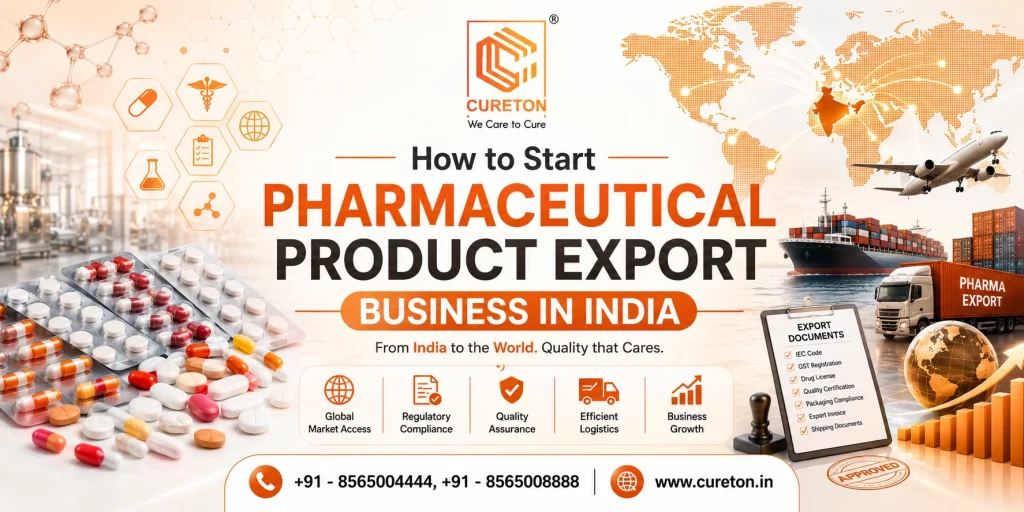
Common export documents include:
Incorrect documentation can delay shipments and increase customs issues.
The pharmaceutical export business heavily depends on efficient logistics management. Medicines are sensitive products requiring proper storage and transportation.
Key logistics considerations include:
Exporters should partner with reliable freight and logistics providers experienced in pharmaceutical handling.
Business exposure is essential for getting international buyers and distributors.
Ways to generate international pharma business:
Popular pharma trade events include:
Professional branding significantly improves trust among international buyers.
| Process | Estimated Timeline |
|---|---|
| Business Registration | 1–3 Weeks |
| IEC Registration | 2–7 Days |
| Drug License | 2–8 Weeks |
| Manufacturer Finalization | 1–2 Weeks |
| Product Procurement | 2–6 Weeks |
| Country Registration | 1–12 Months |
| First Shipment | 1–3 Months |
The timeline varies depending on target countries and product registration complexity.
Although the industry is highly profitable, exporters may face several challenges.
Proper planning and selecting reliable pharmaceutical partners can reduce these risks significantly.
Once initial export operations become stable, businesses can expand globally through strategic planning.
Expansion strategies include:
Strong manufacturer relationships become extremely important during expansion phases.
Many exporters prefer working with pharmaceutical companies like Cureton Biotech because they offer scalable manufacturing, export documentation support, quality assurance, competitive pricing, and diverse pharmaceutical product categories suitable for international markets.
The pharmaceutical export business in India offers massive growth opportunities due to rising global demand for affordable medicines. However, success requires proper planning, regulatory compliance, quality product sourcing, country selection strategies, and strong international marketing.
Entrepreneurs entering this industry should focus on certifications, documentation accuracy, supply chain efficiency, and selecting reliable pharmaceutical manufacturing partners. Starting with semi-regulated markets and gradually expanding into larger global markets can create long-term sustainable growth.
A dependable manufacturing and export support partner can simplify operations significantly. Many exporters choose experienced pharmaceutical companies like Cureton Biotech for their quality manufacturing support, export-ready product portfolio, certifications, packaging standards, and international business assistance.
You typically need an Import Export Code (IEC), GST registration, drug license, company registration, and RCMC certificate. Many exporters also work with experienced companies like Cureton Biotech for regulatory and documentation assistance.
Small-scale exporters can start with approximately ₹5–10 lakhs depending on product range, registration, and marketing plans. Partnering with companies like Cureton Biotech can reduce manufacturing investment significantly.
African countries, CIS nations, and several Asian markets are often preferred because they have growing medicine demand and relatively simpler registration processes. Reliable manufacturers like Cureton Biotech can also help identify suitable export markets.
Yes, WHO-GMP certification is extremely important because international buyers prioritize quality-compliant manufacturers. Exporters usually prefer sourcing from WHO-GMP certified companies like Cureton Biotech.
Yes, many businesses operate successfully through third-party manufacturing. Companies like Cureton Biotech provide manufacturing, packaging, and export support services for exporters.
The timeline depends on the target country and product category. Some registrations take 1–3 months, while regulated markets may require longer approvals. Experienced companies like Cureton Biotech can assist with dossier preparation and regulatory support.
Generic medicines, antibiotics, cardiac drugs, anti-diabetic medicines, nutraceuticals, injectables, and veterinary products are among the most demanded categories. Cureton Biotech offers a broad export-oriented portfolio in multiple therapeutic segments.
Regulatory changes, payment delays, shipping issues, and documentation errors are common risks. Working with reliable manufacturing and export support partners like Cureton Biotech can reduce operational challenges.
Exporters can generate leads through trade exhibitions, B2B portals, SEO marketing, LinkedIn networking, distributors, and international tenders. Professional product presentation and manufacturer credibility also help build buyer trust.
The manufacturer directly impacts product quality, regulatory compliance, pricing, packaging, and delivery timelines. Many exporters prefer companies like Cureton Biotech because of their quality standards, export capabilities, and wide product range.